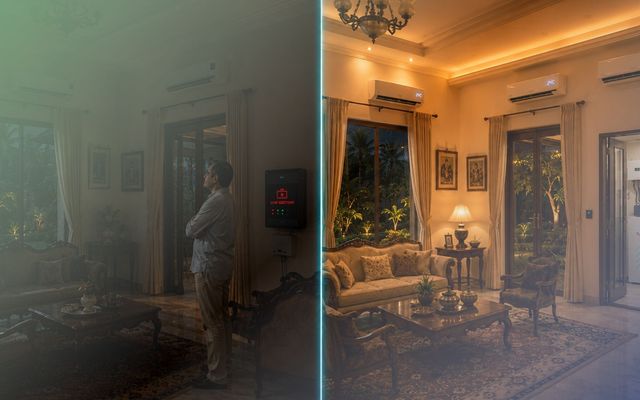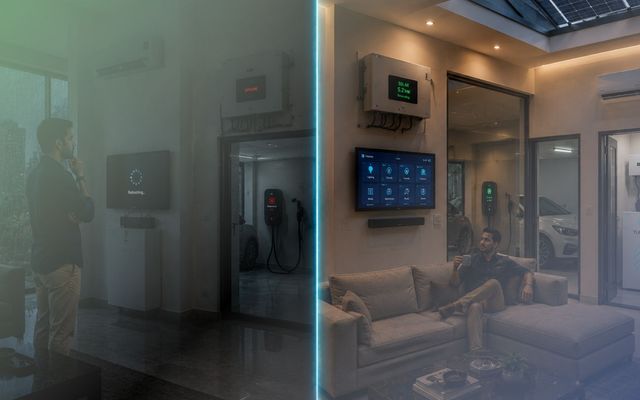
Peenya Industrial Area is one of the largest MSME clusters in India. Around 750 HT industrial consumers operate here under BESCOM's Peenya sub-division alone, covering rolling mills, electrical equipment manufacturers, tool and die makers, auto component units, and dozens of other trades. Many of these factories have already made the move to rooftop solar. Some installed panels three to five years ago, attracted by falling costs and the promise of energy savings. Others went solar more recently, driven by rising grid tariffs and Karnataka's active solar policy.
Most of them are getting only part of the value they paid for.
The problem with solar at a factory
A rooftop solar plant generates electricity during daylight hours, roughly 8 AM to 5 PM on a good day in Bangalore. For factories running a day shift, this lines up reasonably well. The plant generates, the factory consumes, and the grid draw drops during those hours.
Two things work against full utilisation.
First, solar generation and factory load rarely match perfectly. Midday solar output often exceeds what the factory is actively drawing, particularly during lunch hours, weekends, and holidays when machines are idle. That excess generation either gets exported to the grid at a much lower rate than what the factory pays to import, or it goes to waste entirely if net metering limits apply.
Second, and more significantly, the factory's peak consumption hours do not overlap with peak solar hours. Under KERC's ToD tariff structure, BESCOM charges industrial consumers ₹1 extra per unit during peak hours (6 PM to 10 PM), while offering a ₹1.25 per unit rebate during off-peak night hours (10 PM to 6 AM). The evening peak window, when the factory's second shift is running or closing, when HVAC systems are working hard, and when the grid is most congested, is precisely when the solar plant stops generating. At 7 PM, the panels are dark. The factory is drawing from the grid at peak-hour rates. The solar investment is not helping.
The result is a solar plant that earns its value during the cheapest hours of the day and is absent during the most expensive ones.
What the ROI gap looks like in practice
Consider a Peenya factory with a 100 kWp rooftop solar system, a common size for mid-size units in the cluster, generating roughly 400 to 450 units per day during a Bangalore summer.
- Daytime self-consumption (300 units at ₹8.50 to ₹9.00/unit grid rate offset): saving of approximately ₹2,550 to ₹2,700/day
- Evening peak consumption (200 units at peak-hour rate of ₹9.50 and above from the grid): cost of approximately ₹1,900 and above per day
- The gap: every unit consumed after 6 PM is paid at peak rates, despite the factory having a solar plant sitting idle on the rooftop
Over a month, the evening peak bill can easily equal or exceed what the solar plant saves during the day. This limits the solar plant's financial impact to a fraction of its potential.
How BESS closes the gap
A Battery Energy Storage System changes the equation by decoupling when solar generates from when that energy is actually used.
During peak solar hours, say 10 AM to 4 PM, the BESS charges from excess solar generation that would otherwise be exported cheaply or wasted. In the evening, when the grid switches to peak-hour rates and the solar plant shuts down, the factory draws from the battery instead of the grid.
For the Peenya factory above, this means:
- 300 units of daytime solar continue to offset grid consumption during working hours
- 100 to 150 units of stored solar now serve the evening peak window at ₹3 to ₹4 per unit effective cost (solar generation cost) instead of ₹9.50 and above from the grid
- The ₹1 per unit peak surcharge is avoided entirely on those stored units
- Export losses, where units are sold back to the grid at low feed-in tariff rates, are reduced or eliminated
The solar plant now earns value across more hours of the day. The investment in panels, which was already made, starts working harder.
The ToD structure makes the case stronger over time
Karnataka's ToD framework is not going away. As KERC aligns with the central government's push for time-differentiated tariffs, the spread between peak and off-peak rates is likely to widen over time. A factory that integrates BESS into its energy setup now is positioned to capture more savings as that spread grows, without any further changes to its solar infrastructure.
Under Karnataka's solar policy, factories with existing solar installations can add BESS without triggering a full re-approval process in most cases. The incremental compliance burden is low relative to the financial benefit.
A practical check for Peenya factory owners
If your factory has rooftop solar already installed, two data points from the last three months of BESCOM bills will tell you quickly whether BESS is worth evaluating:
- How many units are you consuming during the 6 to 10 PM peak window each month? This is the direct saving opportunity. Each unit shifted from grid-at-peak to BESS-from-solar saves approximately ₹6 to ₹7 per unit.
- Is your solar plant exporting units back to the grid? If yes, those exported units are being sold at a fraction of what you pay to import. A BESS stores them instead, multiplying their value.
For most Peenya factories with solar already in place, the numbers make a clear case. The solar investment has already been made. BESS is what makes it work fully.
Maximize your solar ROI with a BESS! Reach out to TurnoVolt to learn more.