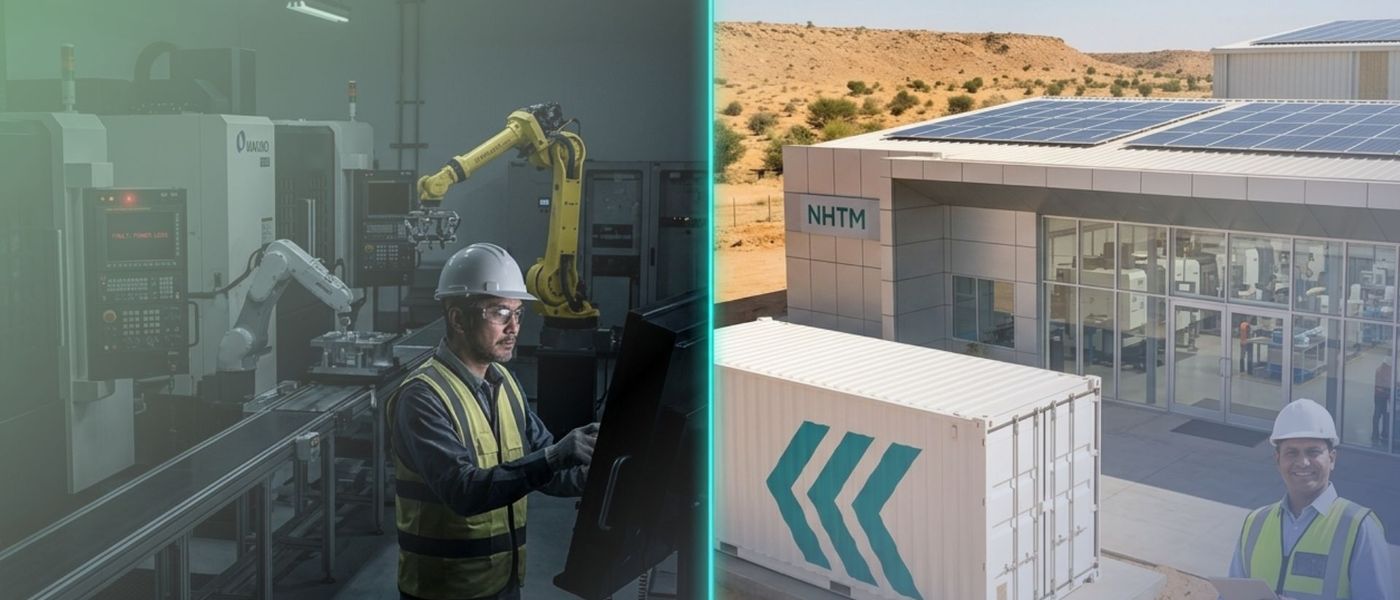
Neemrana has emerged as one of North India's most strategically positioned industrial zones. Located on NH-48 between Delhi and Jaipur, and included within the Delhi-Mumbai Industrial Corridor (DMIC), it hosts a mix of multinational manufacturers, auto component suppliers, electronics units, and Japanese manufacturing companies in the dedicated Japanese Industrial Zone. Factories here operate continuous or near-continuous production schedules. The floor space is modern, the equipment is often imported, and the tolerance for downtime is low.
Yet diesel generators remain a standard fixture across the RIICO industrial area. Generator rental and ownership services in Neemrana deploy units ranging from 15 kVA to 2,000 kVA across the zone. This is not a sign of poor planning. It is a sign that grid supply, despite Neemrana's infrastructure investment, still has enough variability to make diesel backup operationally necessary.
The question worth asking in 2025 is whether the diesel generator is still the best answer to that problem, or whether there is a better one.
Why diesel generators became the default, and why that default now carries a cost
When Neemrana's industrial zones were being developed and populated, diesel generators were the established, reliable answer to grid variability. They were available, serviceable, and understood. Every EPC contractor, facility manager, and factory owner knew how to specify, install, and run one. That familiarity made diesel the path of least resistance.
The problem is that path of least resistance has become significantly more expensive.
Diesel costs ₹22 to ₹25 per unit all-in, accounting for fuel at current prices, engine oil, filters, coolant, and scheduled maintenance. Against the RERC-approved grid tariff for large industrial consumers in Rajasthan, set at ₹6.50 per unit at 11 kV for FY 2026 (RERC tariff orders), every unit generated by the diesel generator instead of drawn from the grid costs approximately ₹16 more than it needs to.
For a Neemrana factory with a 250 kW load running a generator for four hours a day:
- DG cost: 250 kW x 4 hrs x ₹23/unit = ₹23,000/day
- Grid equivalent: 250 kW x 4 hrs x ₹6.50/unit = ₹6,500/day
- Daily overpayment: approximately ₹16,500
- Monthly overpayment: approximately ₹5 lakh
For factories in the Japanese Industrial Zone or the larger RIICO blocks with heavier loads and longer DG runtime, the monthly figure is considerably higher.
The specific problems with diesel generators that factory owners already know
Factory managers who have run diesel generators for years have a working knowledge of everything that goes wrong. It is worth naming these directly, because they are not incidental. They are structural features of the technology:
Startup delay. A diesel generator takes 10 to 30 seconds to start, stabilise, and take on load. For factories with PLCs, CNC machines, servo drives, and precision instrumentation, this gap can cause equipment faults, lost work in progress, and restart sequences that take longer than the outage itself.
Fuel supply risk. Maintaining an adequate diesel inventory requires storage infrastructure, scheduled replenishment, and contingency planning for supply disruptions. A factory that runs out of fuel during an extended outage has no backup at all.
Noise and emissions. CPCB emission norms for diesel generators have tightened significantly. The CPCB IV+ standards require more sophisticated emission controls, and generators that do not comply face regulatory exposure. Noise levels from large DG sets are also a growing concern in industrial zones that have residential development nearby.
Unpredictable maintenance. Generators in continuous industrial use fail. Injector problems, cooling system failures, alternator faults: none of these announce themselves in advance. An emergency repair during a grid outage means the factory is without power entirely.
Total cost underestimation. The ₹22 to ₹25 per unit figure is frequently cited but rarely fully calculated. Unplanned repairs, operator costs, fuel storage maintenance, and efficiency losses from part-load operation all push the true cost higher.
What a BESS does differently, and why it addresses each of these problems
A Battery Energy Storage System is not a backup system in the way a diesel generator is. It is always online, always charged, and always monitoring grid supply. When grid power drops, the BESS switches over in under 20 milliseconds: no gap, no startup, no fuel.
For factories with precision equipment: The millisecond switchover means PLCs, CNC machines, and instrumentation see no supply interruption. There are no fault conditions to clear, no restart sequences to run, and no material losses from interrupted processes.
For factories concerned about compliance: A BESS produces no emissions and no noise during operation. There is nothing to comply with under CPCB emission norms, and no noise to manage in proximity to residential areas.
For factories with solar: Neemrana sits in Rajasthan, which has among the highest solar irradiance levels in India. Many factories in the zone have or are evaluating rooftop solar. A BESS paired with solar stores generation during the day and discharges during outages or peak tariff windows, extending the value of the solar investment significantly.
For the cost calculation: The delivered cost of BESS electricity, grid source rate at ₹6.50 per unit plus approximately ₹2.50 to ₹3.00 per unit for the system, works out to approximately ₹9.00 to ₹9.50 per unit. Against ₹22 to ₹25 for diesel, the saving per unit is ₹13 to ₹16.
The transition question: does this mean removing the diesel generator entirely?
Not necessarily, and not immediately. The practical approach for most Neemrana factories is a hybrid configuration: BESS handles the instant response and covers outages of typical duration (a few hours or less), while the diesel generator remains as a backstop for extended outages. In this configuration, generator runtime drops to a fraction of its current level. Fuel spend falls accordingly. Maintenance intervals stretch out. The generator shifts from being the primary backup to being the last line of defence.
Over time, as confidence in the BESS grows and the factory's specific outage profile is better understood, the role of the generator can be reduced further.
Where to start
For Neemrana factory owners evaluating this shift, three questions are worth beginning with:
- What is the current monthly diesel spend, including maintenance, and how does it compare to the grid electricity bill?
- How much of the generator runtime is during outages of less than four hours, versus extended outages that require sustained diesel backup?
- Are there machines or processes in the facility that are currently experiencing faults or restart losses when the generator kicks in, even though technically power was restored?
The answers to these questions will define both the financial case and the operational case for replacing diesel with BESS at your specific facility.
Explore replacing your Diesel Generator with a BESS! Reach out to TurnoVolt to learn more.