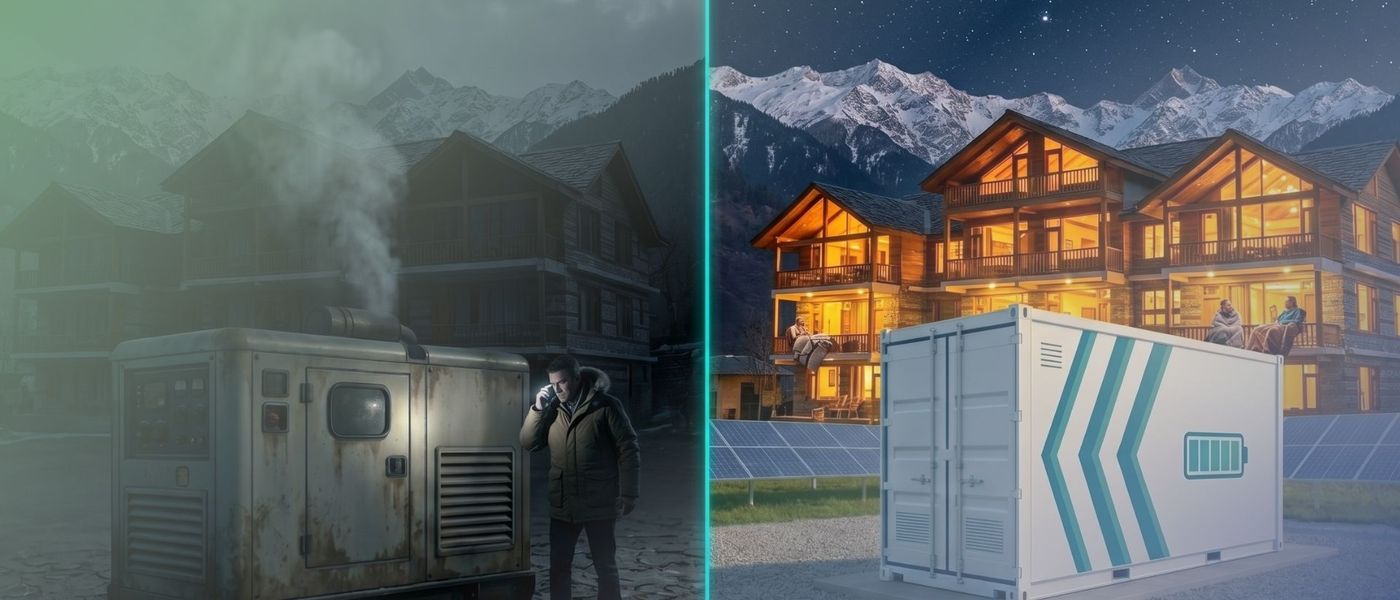
Manali is one of India's most visited hill stations. Tourists arrive year-round - families in summer, backpackers through the monsoon, adventure travellers and skiers in winter. For hotel owners in Manali, peak season means full occupancy, high revenue, and a single thing that can quietly undercut all of it: unreliable power.
Power cuts in Manali are not a rare inconvenience. They are a known, recurring feature of running a hospitality business here.
Why power supply in Manali is structurally unreliable
Manali sits in the Kullu district, served by HPSEB Limited (HPSEBL). The region's grid infrastructure serves a mountainous terrain spread across a wide and difficult geography. The Kullu-Manali belt currently faces a power overload of approximately 2 MW, which regularly forces the electricity board to impose cuts across the area. The Kullu-Manali Hoteliers Association has formally raised this issue with HPSEB on multiple occasions - a sign that it is not an occasional problem but a structural one.
The causes compound seasonally. In winter, heating loads surge as temperatures drop sharply. In summer and peak tourist season, hotel loads - air conditioning, water heating, kitchen equipment, lifts - spike simultaneously across hundreds of properties. In monsoon, storms and landslides damage distribution lines that serve remote stretches of the valley. The result is that the times of the year when Manali hotels are busiest are also the times when power supply is most strained.
A World Bank-funded Smart Grid project worth ₹66 crore has been announced for the Kullu-Manali area to address the overload issue. The project will take time to deliver results. In the meanwhile, every hotel in Manali is managing the problem on its own.
What power cuts cost a Manali hotel - beyond the diesel bill
Most Manali hotels run diesel generators as their primary backup. The generator starts when the grid fails, guests notice nothing, and the fuel invoice arrives at the end of the month. This is how the cost gets absorbed - quietly, month after month, without a clear line item that captures its full impact.
Diesel costs ₹22–25 per unit all-in, against a grid commercial rate of ₹6.40 per unit for consumers up to 20 kVA under the HPERC tariff order effective April 2025 (HPERC tariff orders). The gap - roughly ₹16–18 per unit - is the direct cost of every unit generated by a generator instead of drawn from the grid.
For a 30-room hotel with a 50 kW average load running a generator for six hours a day during peak season:
- DG cost: 50 kW × 6 hrs × ₹23/unit = ₹6,900/day
- Grid equivalent: 50 kW × 6 hrs × ₹6.40/unit = ₹1,920/day
- Daily overpayment: ~₹4,980
- Monthly overpayment during peak season: ~₹1.5 lakh
For larger properties with higher loads, or during winter months when generator runtime is longer, these numbers scale considerably.
Beyond the fuel cost, there are dimensions that show up in ways hotels don't always connect to power:
- Guest experience. A generator that starts at 11 PM when the grid fails is audible - in corridors, in rooms, through walls. The noise is manageable in a budget property. In a heritage hotel, a boutique stay, or a property charging ₹8,000–15,000 a night, it is a problem that shows up in reviews.
- Kitchen and cold storage continuity. A grid failure during meal service interrupts kitchen operations. Cold storage without backup power risks food spoilage during extended outages.
- Water supply. Manali hotels depend on electric pumps for water pressure. A power cut without adequate backup means no water to rooms - a complaint that arrives at the front desk within minutes.
How BESS changes the backup model for a Manali hotel
A BESS operates silently and instantly. Unlike a generator, there is no startup delay - the switchover happens in milliseconds, meaning lights, heating, kitchen equipment, and water pumps continue without interruption. Guests do not know the grid has failed.
For a Manali hotel, the practical shift is significant:
- Silent operation. No generator noise. The experience the hotel is selling - a quiet mountain retreat - stays intact through the outage.
- Reduced DG dependence. For outages of a few hours, the BESS handles the load entirely without the generator starting. Generator runtime drops sharply, and with it, fuel costs and maintenance frequency.
- Solar compatibility. Many Manali hotels have rooftop solar or are evaluating it. At Manali's altitude, solar irradiance is strong and generation hours are meaningful. A BESS stores that generation for use during evening and night hours - or during grid failures - dramatically improving the return on the solar investment.
- Lower effective electricity cost. The BESS charges from the grid at ₹6.40 per unit and delivers electricity at that cost plus approximately ₹2.50–3.00 per unit for the system - still far below the ₹22–25 per unit diesel alternative.
What to assess first
For Manali hotel owners evaluating whether BESS makes sense for their property, three questions are worth starting with:
- How many hours per day does the generator run, averaged across peak and off-season months?
- What is the total annual spend on diesel, including maintenance - and how does that compare to your electricity bill from the grid?
- Are any guests currently experiencing noise, interruptions, or service gaps during power cuts that may be showing up in reviews?
The answers to these questions will tell you both the financial case and the guest experience case for BESS at your specific property.
Ensure continuous power supply with a BESS! Reach out to TurnoVolt to learn more.