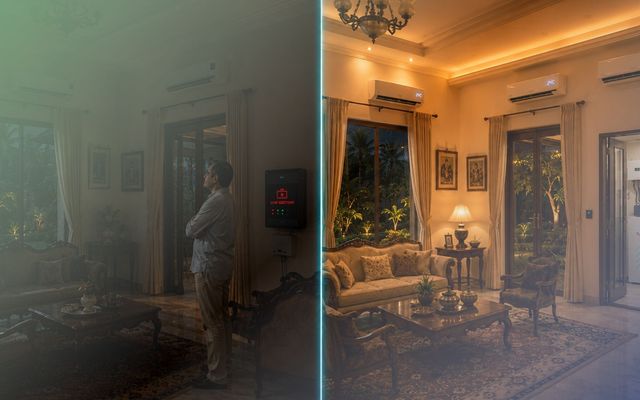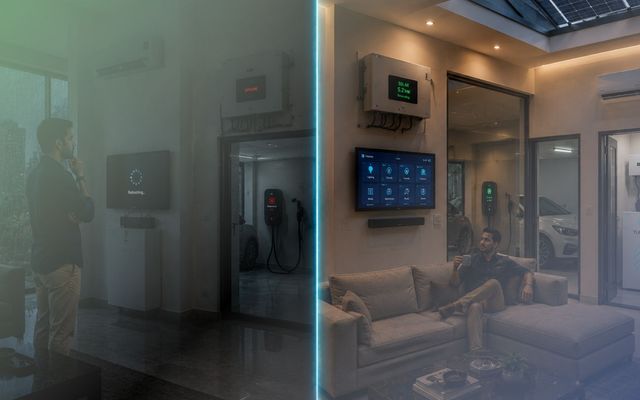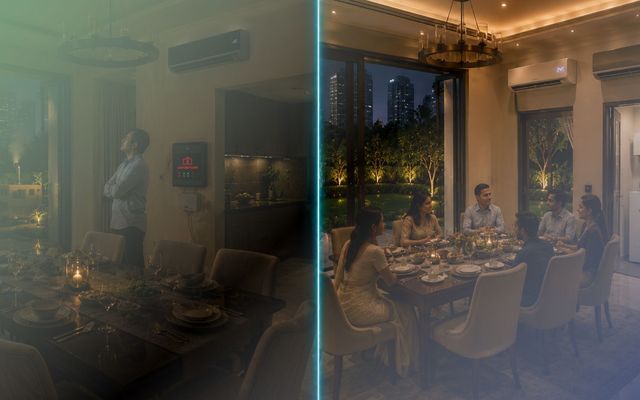
You have a UPS. You have an inverter. And when the power goes out in Whitefield or Sadashivanagar, you know exactly what happens next. The lights stay on. The fans keep running. The air conditioning stops. The lift stops. The kitchen goes quiet. And everyone in the house adjusts, because that is what the inverter was built to do. Keep a few things running. Not everything.
That adjustment has a name. It is called a compromise. And it has no place in a home built to this standard.
What an inverter actually does, and what it does not
A conventional home inverter or UPS is sized for a partial load. It was designed at a time when the assumption was that during a power cut, you would turn the ACs off, manage with reduced lighting, and wait it out. That assumption made sense once. It does not anymore.
A premium home in Bangalore today runs on full load continuously. The air conditioning is not optional in April. The lift is not a luxury when elderly family members are in the house. The home automation, the security system, the refrigerator, the entertainment system: none of these are things a household of this standard switches off and waits out.
A conventional inverter cannot run this load. It was never meant to. And no amount of upgrading the battery bank changes that, because the limitation is in the design of the system, not the size of the battery.
BESCOM will have its moments. Your home will not notice.
BESCOM outages in Bangalore are a known feature of life, particularly in summer when the grid is under maximum load, and during monsoon when storms bring down feeder lines across the city. Even in Bangalore's most premium addresses, the grid is shared infrastructure. It serves everyone, and it fails everyone equally.
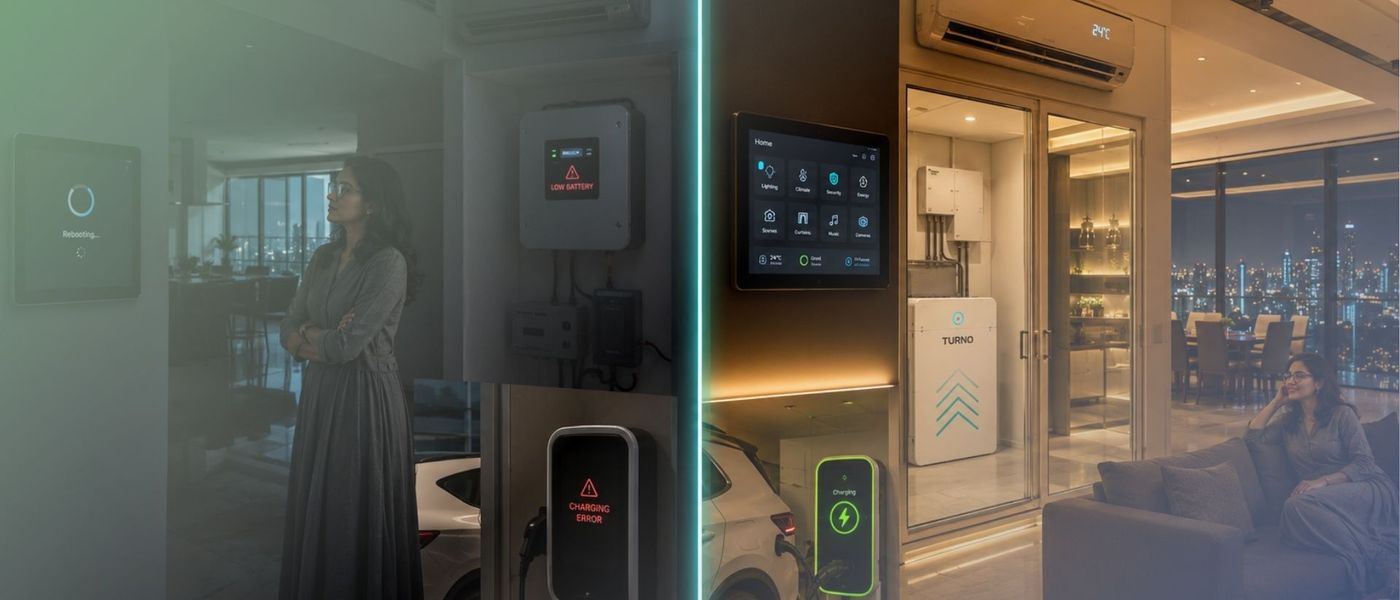
Turno BESS monitors grid supply continuously. When BESCOM fails, Turno switches over in under 20 milliseconds. The ACs keep running. The lift keeps moving. The automation stays in its programmed state. The kitchen appliances stay live. Nothing reboots. Nothing resets. Nobody in the house knows the grid has failed.
Not because the problem was managed. Because the problem simply did not exist.
Not a backup. A power plant.
This is the distinction that matters. A UPS or inverter is a backup device. It sits idle, waiting for a failure, and when that failure comes, it delivers a reduced version of normal life until the grid returns.
Turno is not a backup. It is a permanent power source. It runs the whole home, ACs, lift, and all, whether the grid is up or down. The grid becomes a charging source, not a dependency. When it is there, Turno uses it. When it is not, Turno does not need it.
The days of managing a power cut are over. There is nothing to manage.
A quick look at the numbers
A premium Bangalore home currently spending ₹3 to ₹5 lakh annually on diesel and generator maintenance eliminates most of that cost in the first year. Paired with rooftop solar, Turno stores daytime generation and uses it through the evening, reducing the grid electricity bill further. Combined annual savings can reach ₹4 to ₹6 lakh for a large independent home.
Battery storage systems installed alongside solar qualify under central government clean energy incentive frameworks, with applicable GST and depreciation benefits depending on system configuration.
The upgrade the inverter was never going to be
The inverter was the right answer for its time. That time has passed. A home in Bangalore that has invested in the best of everything deserves power infrastructure that matches that standard.
Turno runs the whole home. ACs, lift, and all. You stop thinking about power. It just runs.
Upgrade your villa’s power infrastructure with BESS! Reach out to TurnoVolt to learn more.