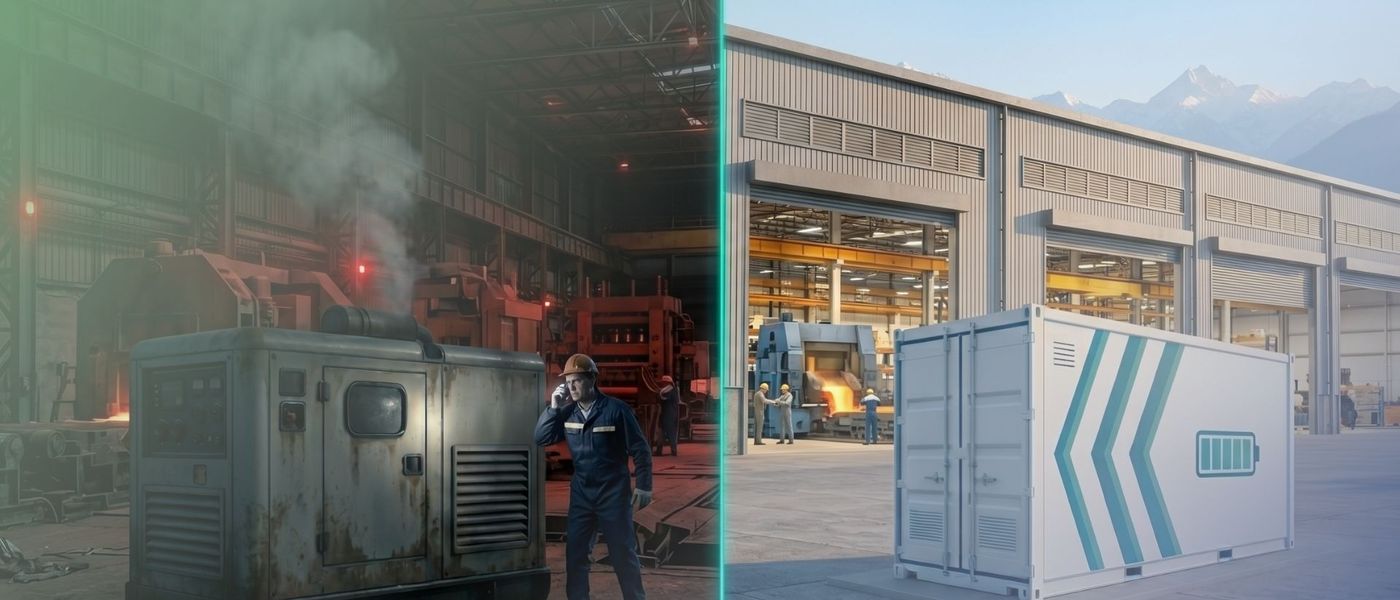
Durgapur was built around heavy industry. Steel, chemicals, engineering goods, and ancillary manufacturing have been the backbone of this city for decades. The factories here are not small - many operate large machinery, continuous process lines, and multi-shift schedules. Power is not just a utility for a Durgapur factory; it is a production input, as critical as raw material.
That is what makes diesel generator costs so damaging here. When the grid fails - and it does - the generator starts. And every hour it runs, money that should be going into production margins is going up the exhaust pipe instead.
Durgapur's grid and the DG dependence it creates
Durgapur falls under the erstwhile DPL (Durgapur Projects Limited) distribution zone, now absorbed into WBSEDCL. The industrial belt here has historically faced grid reliability challenges common to older, heavy-load zones - transformer faults, feeder outages, and seasonal stress during summer months when demand spikes. For factories running continuous or near-continuous operations, even a few hours of grid downtime per week adds up to significant generator runtime across a month.
Unlike factories in newer industrial zones that are designed around stronger grid infrastructure, many Durgapur units have generations of operational history that predate modern grid reliability standards. The response to outages has always been the same: keep a generator running and absorb the cost.
That cost has become harder to absorb.
What diesel actually costs a Durgapur factory today
The all-in cost of running a diesel generator - fuel, engine oil, filters, coolant, and routine service - works out to ₹22–25 per unit. This is the number most factory managers carry in their heads, but it often understates the true figure once unplanned repairs, emergency fuel procurement at premium rates, and operator costs are included.
Compare this to what the same electricity costs from the grid. Under the WBSEDCL tariff order effective April 2025 (WBSEDCL tariff notifications), HV industrial consumers in the Durgapur zone pay in the range of ₹7–8 per unit for energy charges, with demand charges on top.
Even at the conservative end, the gap between grid power and diesel power is ₹14–17 per unit. For a factory running a 300 kW load on DG for five hours a day:
- DG cost: 300 kW × 5 hrs × ₹23/unit = ₹34,500/day
- Grid equivalent: 300 kW × 5 hrs × ₹7.50/unit = ₹11,250/day
- Daily overpayment: ~₹23,250
- Monthly overpayment: ~₹7 lakh
That is a significant sum - and for a factory running two or three shifts with high machinery loads, the numbers scale further.
The maintenance cost that compounds the problem
High generator runtime creates a second problem that shows up in maintenance budgets rather than fuel invoices.
Diesel generators in continuous industrial use require major servicing every 500–1,000 hours of runtime. For a factory where the generator runs 5 hours a day, that means a major service interval every three to six months - far more frequently than the annual schedule most facilities plan around. Engine wear is proportional to runtime, and generators in Durgapur's climate - high humidity, dust from nearby industrial operations - tend to age faster than the manufacturer's specifications assume.
An unplanned generator failure mid-production shift is not just a maintenance cost. It is lost output, missed delivery windows, and in continuous-process industries, potential material spoilage. These costs are real but rarely traced back to the generator in monthly reviews.
How BESS changes the equation
A Battery Energy Storage System charges from the grid during normal supply hours and takes over instantly when the grid drops - silently, without fuel, and without the startup delay of a generator. For a Durgapur factory, the practical impact is straightforward:
DG runtime drops sharply. The BESS handles the outage period. The generator either does not start at all for shorter outages, or serves only as a backstop for extended failures - drastically reducing monthly fuel consumption and service intervals.
Cost per unit falls significantly. The delivered cost of BESS electricity - grid source rate plus approximately ₹2.50–3.00 per unit for the system - works out to around ₹10–11 per unit. Against diesel at ₹22–25, the saving per unit is ₹12–15.
Production continuity improves. The switchover from grid to BESS happens in milliseconds, unlike the 10–30 second gap with a generator. Machinery, process controls, and instrumentation stay live without interruption.
A note on the Durgapur industrial mix
Heavy industries - steel, chemicals, engineering - often have loads that are particularly sensitive to supply interruptions. Arc furnaces, induction heaters, CNC machines, and precision instruments can be damaged or require lengthy restarts after even brief power dips. For these facilities, BESS is not only a cost measure but a production reliability measure. The two benefits compound each other.
For lighter manufacturing - packaging, fabrication, assembly - the case is primarily economic, and the numbers above tell that story clearly.
Where to start
Three data points are enough to begin a meaningful evaluation:
- Monthly diesel consumption in litres - and what that translates to in rupees, including service costs over the last year
- Average daily generator runtime - broken down between outage-driven use and planned supplementation
- Critical loads - which machines or processes cannot tolerate even a brief power interruption, and whether those are currently protected
With these three numbers, the saving from replacing generator hours with BESS can be modelled precisely for a Durgapur factory's specific situation.
Save on diesel costs with a BESS! Reach out to TurnoVolt to learn more.