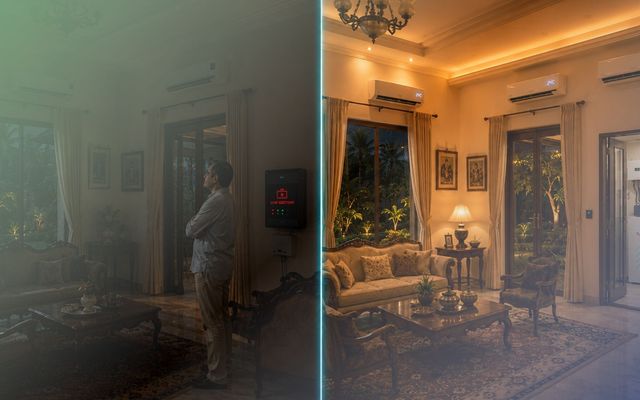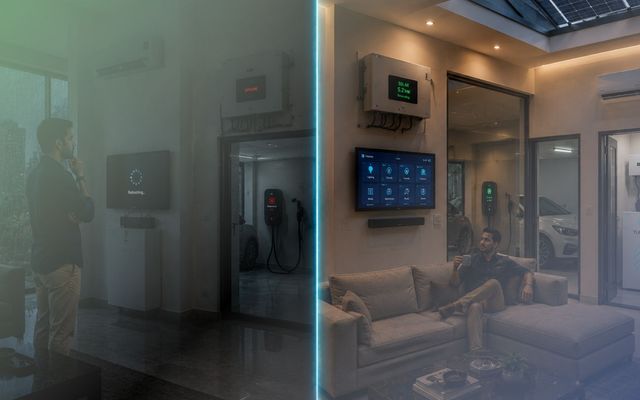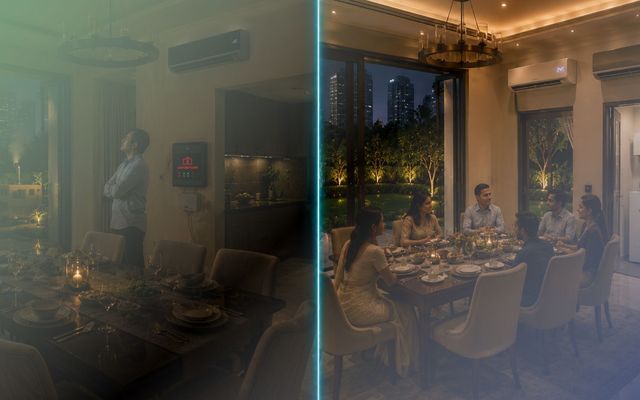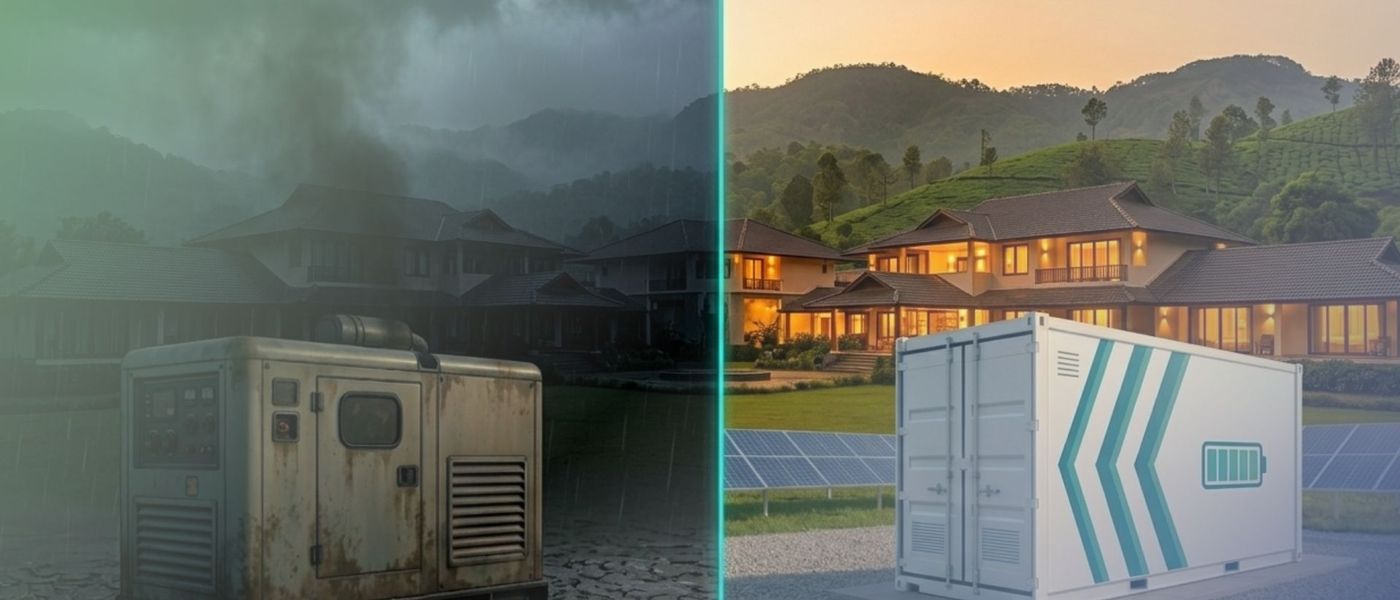
Coorg sells a particular kind of experience - mist over coffee estates in the morning, the sound of the Kaveri in the distance, a property that feels removed from the noise of the city. Guests arrive from Bengaluru, Chennai, and Hyderabad specifically to slow down. What they do not come for is the generator kicking on at 9 PM.
And yet, for most resort owners in Kodagu, that is exactly what happens.
Power cuts in Coorg are not a rare event
Kodagu's grid infrastructure serves a mountainous district spread across remote estates, forest zones, and terrain that is genuinely difficult to maintain. Scheduled maintenance outages from CHESCOM (Chamundeshwari Electricity Supply Corporation) are a regular part of life here - often running several hours at a stretch. On top of those, unscheduled outages from monsoon storms, fallen trees, and transformer faults add further unpredictability. During peak monsoon months - June through September - the frequency and duration of outages increase significantly as heavy rains and strong winds damage distribution lines across the Western Ghats.
For a resort, this creates a problem that is as much about guest experience as it is about operations.
What a power cut costs a Coorg resort - beyond the electricity bill
The obvious cost is diesel. Most resorts in Coorg run generators as their primary backup, burning diesel at ₹22–25 per unit all-in. For a property running a 50 kW load across a full monsoon season with frequent grid failures, diesel costs can run into several lakhs a year.
But the less obvious cost is harder to quantify and more damaging in the long run: the guest experience.
Coorg attracts a guest who has chosen to pay a premium - for a pool villa, for a coffee estate stay, for a property that signals quality. That guest has almost certainly read reviews before booking. And the review that mentions a generator roaring to life mid-dinner, or the lights flickering during the evening, or the air conditioning cutting out at midnight - that review stays on the page for months or years, and it costs the property bookings it will never know about.
Running a noisy diesel generator is also increasingly difficult in ecologically sensitive areas. Noise pollution regulations in forest-adjacent and wildlife-buffer zones around Kodagu are tightening, and CPCB emission norms add compliance complexity. Beyond regulation, it simply does not fit the narrative that any serious resort in Coorg is trying to tell - about sustainability, about nature, about a low-impact stay.
What BESS changes for a Coorg resort
A BESS operates silently. There is no startup noise, no fumes, and no interruption when the grid drops. The switchover happens in under 20 milliseconds - meaning the lights stay on, the music continues, and the kitchen keeps running without anyone in the dining room noticing anything at all.
For a resort property, this has several practical benefits:
- Guest experience is uninterrupted. Evening dinners, spa sessions, and poolside evenings are not punctuated by generator noise or supply dips. The experience the property is selling stays intact.
- Operations continue normally. Kitchen equipment, cold storage, water pumps, and HVAC all stay running during a grid outage. There is no scramble to manage diesel tanks or monitor fuel levels.
- The sustainability story is consistent. A resort in Coorg that is serious about its environmental positioning - solar panels, organic food, estate walks - now has an energy system that matches that narrative. Diesel generators undercut it.
- Solar works through the night. Most Coorg resorts have rooftop solar or are evaluating it. The problem with solar in a grid-outage scenario is well understood - grid-tied solar shuts down when the grid fails. With BESS, the solar generation stored during the day continues to power the property through the evening and overnight, which is precisely when Coorg's loads peak - lighting, dining, heating, and guest amenities.
The economics work especially well for properties with existing solar
A resort that already has solar is leaving money on the table every time the grid goes down. The solar plant shuts off, the generator starts up, and the gap between ₹3–4 per unit (solar cost) and ₹22–25 per unit (diesel cost) gets paid out of the property's margins.
BESS closes that gap. The stored solar energy serves the property during outages and during peak evening hours, dramatically reducing the hours the generator needs to run - and in some configurations, eliminating daytime generator use entirely.
A practical starting point for Coorg resort owners
The right sizing for a BESS depends on the property's load profile and how long outages typically last in your area. A few useful data points to gather before evaluating:
- What is your average monthly diesel consumption, and how much of it is during grid outages vs. peak demand periods?
- How many hours per day does the generator run, on average, across monsoon and off-season months?
- Does the property have rooftop solar, and if so, how much of the generation is currently being wasted when the grid is down?
- What is the typical outage duration in your area - a few hours, or full-day maintenance cuts?
The answers will quickly indicate what size BESS makes sense and what the payback looks like. For most Coorg resorts with meaningful solar capacity and significant diesel bills, the case is strong.
Ensure continuous power supply with a BESS! Reach out to TurnoVolt to learn more.