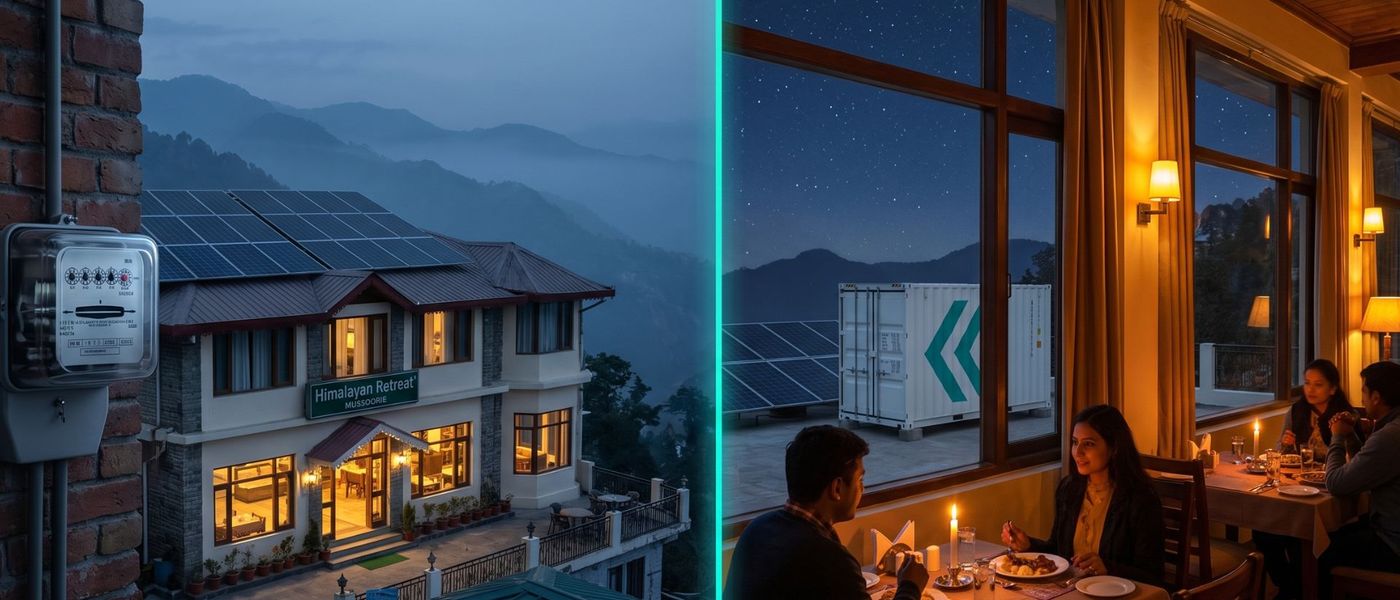
Mussoorie sits at around 2,000 metres above sea level on the southern slopes of the Garhwal Himalayan range. It is one of North India's oldest and most established hill destinations, drawing visitors from Delhi, Chandigarh, and the NCR throughout the year. The hotels and resorts here range from colonial-era heritage properties on the Mall Road to newer mountain retreats on the quieter Landour and Camel's Back road stretches.
What most of these properties share, increasingly, is a rooftop solar installation. And what most of them are discovering is that the solar plant is not delivering the return they expected.
Why Mussoorie's solar potential is genuinely strong
Uttarakhand receives average solar insolation of more than 5 kWh per square metre per day, and 58 percent of the state's land area receives solar radiation above 4 kWh per square metre per day year-round. Mussoorie's elevation and south-facing slopes mean hotels on the right aspects of the hill get strong direct irradiance during clear-sky days, particularly from October through June when cloud cover is minimal.
The Uttarakhand government has actively promoted solar adoption through the PM Surya Ghar Yojana and state-level subsidy schemes administered by UREDA (Uttarakhand Renewable Energy Development Agency). A 3 kW system in Dehradun or a comparable site like Mussoorie produces approximately 450 units per month. For a hotel with a larger system, say 30 to 50 kWp, monthly generation during good months can reach 4,000 to 7,000 units.
The solar potential is real. The problem is what happens after 5 PM.
The mismatch between when solar generates and when a hotel actually needs power
A hotel's electricity consumption does not follow the sun. The heaviest loads in a Mussoorie property run in the evening and at night: room heating in winter, hot water across all rooms, kitchen operations during dinner service, lighting, and the lobby and corridor loads that run continuously after dark.
Solar generation peaks between 10 AM and 3 PM, which overlaps with the lightest part of a hotel's daily load profile. Check-out time is typically mid-morning. The kitchen is preparing for lunch. Rooms are being cleaned. The heaviest loads are off.
By 5 PM, when room occupancy peaks and the dinner kitchen starts, the solar plant has stopped generating. The hotel switches entirely to grid power. And in Uttarakhand, that grid power is getting more expensive.
UPCL has proposed a tariff hike of 16.23 percent for FY 2026-27, with the potential increase reaching 18.50 percent if all UERC claims are accepted. Commercial consumers at current rates already pay in the range of ₹7 to ₹8 per unit, with tariff increases proposed for the coming financial year. The evening hours, when the hotel is drawing its heaviest grid load, are becoming the most expensive hours of the electricity bill. The solar plant, which could offset some of this, has already gone quiet.
The result is a solar installation that saves money during the day when consumption is low, and sits idle during the evening when consumption is high. That is not the return the investment was meant to deliver.
What BESS does to fix the utilisation gap
A Battery Energy Storage System stores the solar generation that exceeds the hotel's daytime consumption and makes it available in the evening and at night. The mechanism is straightforward:
- Between 10 AM and 3 PM, while solar output is at its peak, the BESS charges from excess generation that the hotel is not immediately consuming
- From 5 PM onwards, when the solar plant shuts down and the hotel's load peaks, the battery discharges into the hotel's circuits instead of drawing from the grid
- The effective cost of that evening electricity is the solar generation cost, approximately ₹3 to ₹4 per unit, rather than the grid rate of ₹7 to ₹8 per unit
For a 40-room hotel with a 50 kWp solar installation consuming 200 units per evening from the battery instead of the grid:
- Grid cost avoided: 200 units x ₹7.50/unit = ₹1,500/day
- Effective BESS cost: 200 units x ₹3.50/unit (solar generation cost) = ₹700/day
- Daily saving: approximately ₹800
- Monthly saving: approximately ₹24,000
- Annual saving: approximately ₹2.9 lakh
This is saving on top of whatever the solar plant is already saving during daytime hours. The solar investment is already in place. BESS extends its working hours into the part of the day where it was previously contributing nothing.
The power cut benefit comes included
Mussoorie, like most hill stations in Uttarakhand, experiences scheduled maintenance cuts and occasional unscheduled outages from infrastructure faults and weather events. A BESS installed for solar utilisation also serves as an instant backup during these outages, switching over in milliseconds with no generator noise and no fuel requirement.
For a heritage property or a premium mountain resort, this dual benefit matters. The solar saving reduces the running cost of the property. The backup capability removes the need to run a diesel generator for routine outages, which can further reduce diesel spend by several lakhs per year depending on the property's current DG runtime.
Tariff direction makes the case stronger over time
With UPCL proposing hikes of 16 to 18 percent for FY 2026-27, the gap between grid electricity cost and solar-generation cost will widen further. A hotel that has BESS in place to shift stored solar into evening consumption captures an increasing saving with each tariff cycle, without any modification to the solar installation or the BESS system.
Where to start
For Mussoorie hotel owners with existing rooftop solar, two data points from the last three months of UPCL bills will confirm whether BESS is worth evaluating:
- How many units is the solar plant exporting to the grid under net metering? Exported units represent generation that was sold at a low feed-in rate instead of being used at a high grid-import rate. Every exported unit is a BESS opportunity.
- What is the hotel's monthly consumption between 5 PM and 10 PM? This is the direct evening saving window. Each unit shifted from grid supply to stored solar reduces the bill at the full commercial rate.
For most Mussoorie hotels with a solar installation of 20 kWp or larger, the numbers make a straightforward case. The solar was the first step. BESS is what makes the full day productive.
Want to find ways to get more out of your stored solar power with a BESS? Reach out to TurnoVolt to learn more.